Showing posts with label Game. Show all posts

6.03.2014

Bentenjima Hanabi

This weekend, Dustin and Theo biked the Shimanami Kaido. This was the first time that Theo has been on this cycling route and the fifth or sixth time for Dustin. I will try to convince Dustin to write a post about their adventures in the next week. The two younger kids and I decided to stay home, firstly because I was working in the morning and early afternoon, and secondly because that evening was the annual Bentenjima fireworks festival. Our friends, the Oshimas, watched Rosie and William while I was at work and as soon as I returned home, I threw on some yukata and headed out the door.

The fireworks are held each year in Tomonoura and as always, it was incredibly lively and crowded. William was exited enough to add a new word to his repertoire: hanabi, or fireworks. We arrived early enough to get a parking spot, wander around the street stalls, and find a good spot to view the fireworks.

William demanded a photo in front of this firetruck 
Overpriced, unhealthy, but oh, so delicious!
This was my first time to see a chocolate and sprinkle covered banana stand
I thought these Anpanman candy covered apples were great. The lady in the background was busy
making a Hello Kitty candy apple. 
Happy as Larry he was
and totally oblivious to the samurai father and son sneaking up on him

There are a lot of different stalls that allow children to "fish" for toys. At this stall, you pay to get one metal hook attached to a short piece of twisted tissue paper. The object is to hook as many of these balloons without getting the piece of paper wet and losing your hook. Once the paper breaks, you must stop fishing, but until then you can keep whatever you hook. William got one balloon before he got impatient and ripped his hook off the paper for no reason. Maybe he is a bit too young for this game? 

A similar game involves a little plastic hoop with rice paper stretched in between and a collecting bowl. You then try and scoop as many balls, toys, or whatever out of the water and into your bowl before your paper net breaks. There is an art to it: you need to work fast because the paper breaks down quickly once it is wet, but you can't get too greedy and scoop too much. Whatever you collect in your bowl before your net breaks you can keep. 


This stand lets you scoop up goldfish with a paper net which I think is pretty sad.


I thought this mom and her tiny little girl in yukata were so incredibly cute.
William, Rosie, and me

All thoughts of fireworks were temporarily forgotten when William found a new little friend on the sidewalk. It was a funamushi, or sea slater, which was very friendly and docile. It is an oniscid isopod, very closely related to pill bugs, which are actually crustaceans and not insects like most people think. One of William's favourite pastimes is playing with pill bugs in our yard so it was not at all surprising that he found the sea slater so appealing. He discovered the "fun" in "funamushi" by letting it scamper all over his hands and arms, carrying it around, and creeping out anyone who came close enough to see.

I think someone drew on its back because they don't naturally have white markings

Rosie occupied herself by picking up rocks and trying to eat them, one of her all time favourite hobbies.


 And puttering around the street stalls taking in all the new sights.


This was her first real fireworks show and I was curious to see how she would react to all the noise and lights. Thankfully, she shrieked in joy and clapped her hands as each firework boomed in the sky. The boys were always pretty mellow about fireworks when they were babies, so her overboard enthusiasm surprised me.
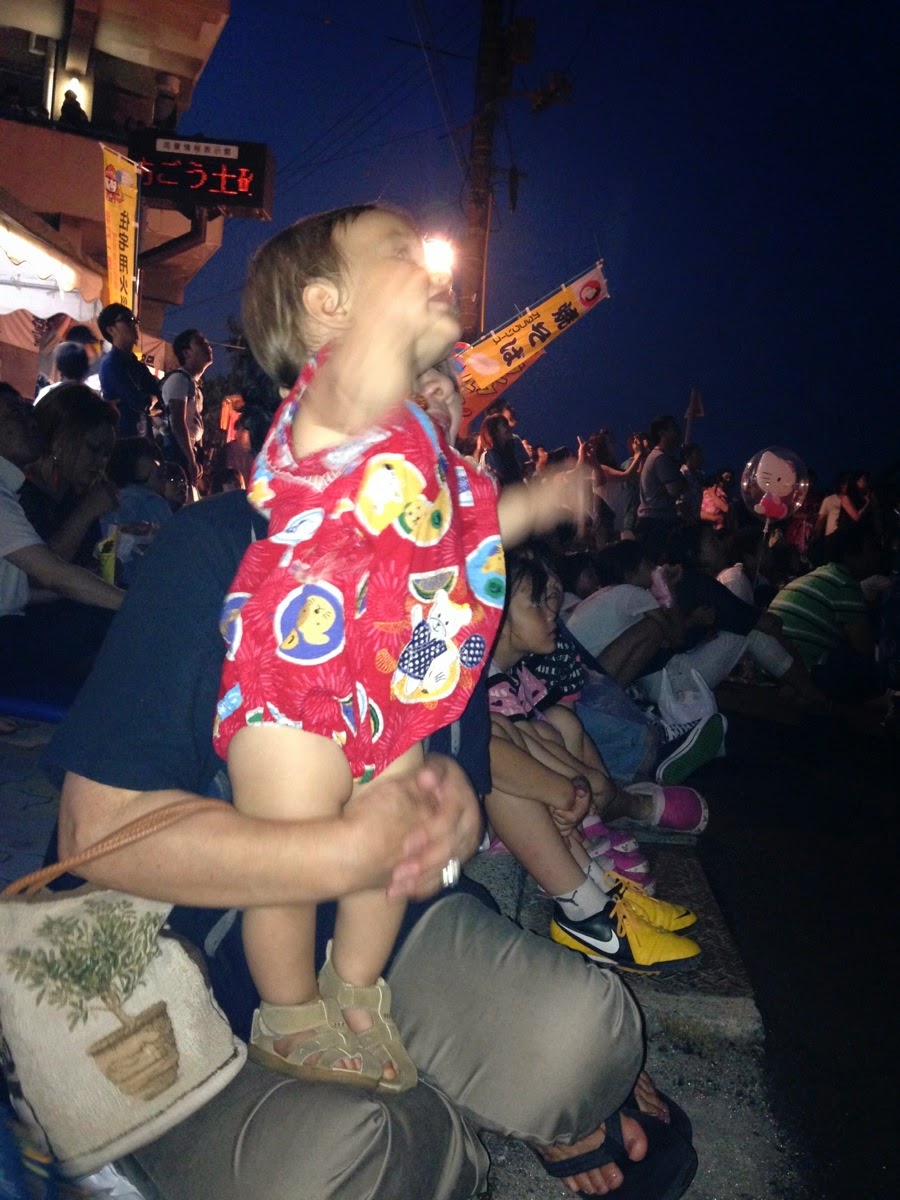

Looks like we'll have to go to more fireworks shows this summer! 


1.25.2012

Rodents of Unusual Size

One critter that we see fairly often on our bike rides is the nutria, or coypu (Myocastor coypus). They seem to be everywhere in the canals and in the Ashida River that flows through the city. As you can see from this shot of one I took this weekend, they are a semi-aquatic rodent are about the same size as a beaver but with a long, rat-like tail.
I am surprised this one let me get so close


Originally from South America, they have been introduced to every continent except for Antarctica and Australia for their fur. Nutria were introduced to Japan in 1910 and the military promoted small fur farms to raise nutria. When the price of the pelts dropped, many nutria were released into the wild where they happily procreated, due to a lack of natural predators and lots of prime habitat. Since 1963, nutria have been hunted in Japan to control their ballooning population. When looking for population counts in Japan, I discovered that Okayama has the highest number of nutria in the country. It is about 9.5 kilometers from our apartment to the border of Okayama Prefecture, so it makes sense that I see them so often.

Super cute baby nutria
The foraging and nesting habits of the nutria have an incredibly detrimental effect on the health of wetlands and water systems in the countries in which they are introduced. They destroy nesting habitat for native species and cause massive soil erosion by eating marsh plants and burrowing through root systems. Places like Louisiana (are you surprised?) have created a 5$ bounty for every nutria shot in an attempt to decrease their population. Some countries are even trying to popularize the sale of nutria meat for human consumption. The meat has euphemistically been named "ragondin", the French word for nutria, and has been found to be much leaner, higher in protein, and lower in harmful microorganisms compared with farmed conventional meats. If you ever manage to get your hands on some ragondin, there are lots of recipes out there that will help you make the most of it.

Shooting them for fur, meat, or even a 5$ bounty may seem cruel, but in many of the countries to which they have been introduced, humans are the only predator able to lower their populations. The wetlands they are destroying are incredibly complex and fragile habitats which play a critical role in maintaining water quality and species richness. In many countries, hunting, whether done by individuals or the government, is one of the few viable options for controlling their population. I say, if you are going to shoot it anyway, why let it go to waste?