
So, it has happened again. Somehow, without being really aware of it, the few suitcases of personal items we brought to Japan increased until we are now able to comfortably fill and furnish a small house. Our furnishings are still pretty spartan compared with most of the Japanese houses and apartments we have been to though. Dustin and I have noticed people's tendency to have towering mountains of furniture and assorted stuff that stretches to the ceiling and covers almost every available bit of flooring. I am pretty sure that I would lose my mind if I had to spend every waking moment keeping the boys from bounding into, climbing, and toppling endless stacks of stuff. Maybe this is why children here are kept out of the house in day cares, kindergartens, and endless extra curricular classes from such an early age.
Without further ado, here is a tour of one half of our new place:
When you enter through the front door, you find yourself in a large, old style genkan. There is a 36 cm step from this concrete entrance area onto a wooden landing that takes you into the rest of the house.
 |
| ただいま! |
From the landing, there is a door to the left, a door to the right, and a flight of stairs leading to the second floor. Today, we will enter through the door on the left.
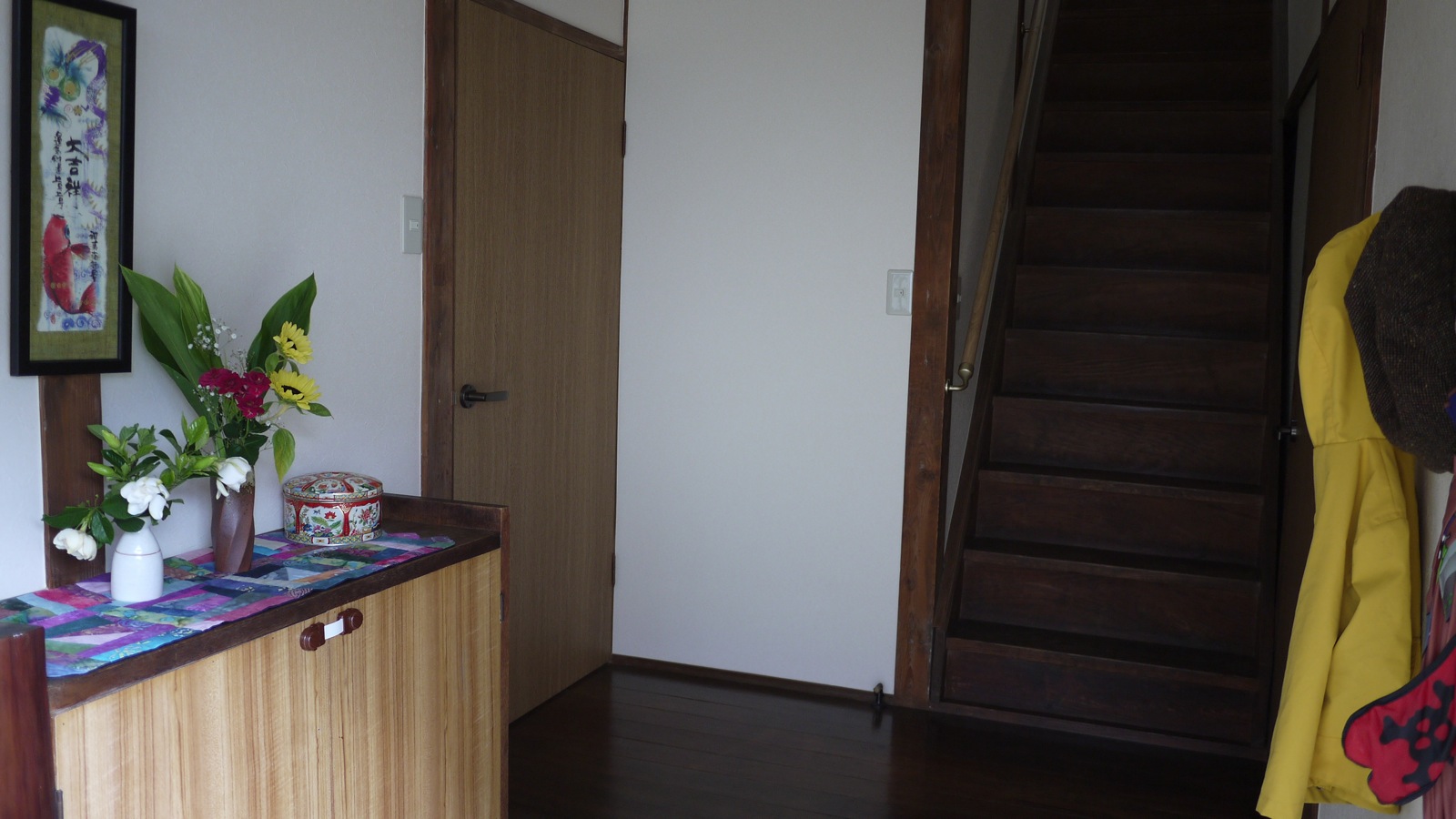
Beyond the door is a small sunroom with large sliding patio doors on the left and a tatami "living room" on the right.

Here is a view of the sunroom from inside the tatami room.

This is the tatami room that we have turned into our living room

And here is a different angle of the room showing the traditional shrine alcove which has been turned into our TV corner. This is no reflection on how much importance we place on our television, but was just a nice out of the way spot for it. Theo seems pretty pumped about playing Smooth Moves. There is a big closet with double sliding doors on the back wall and a door that leads to the washing machine and shower area between the closet and the couch.

When you go through this door, you find yourself in a short hallway where the washing machine is located.

To the left of the washing machine there is a doorway that leads to the fully waterproof bath/shower area.

For those of you who have never had the pleasure of using a Japanese bathtub, here is a closer look at it. It is not as long the bathtubs we have in the West, but much deeper. It is about 50 cm deep so you can immerse much more of your body in the water.

It also has a complicated and new fangled set of controls that allows you to adjust the temperature, fill the tub at the touch of a button, and circulate the water in the bathtub through a heater that maintains it at the same temperature throughout your bath. Also, the water can be saved and reheated in the future to whatever temperature you like by pressing a button. This might seem strange, but since you fully scrub yourself down before getting in, the water is clean enough to save for the next bath.

The thing that attracted us to this house was the perfect blending of old and new. We are guessing that it was built during the post war reconstruction period, which puts it at about 60 - 65 years old. There are a lot of aspects that have been kept in their original state, like the large, deep genkan, or entranceway, the worn wooden stairs and landing, the deep windowsills, and old exposed timbers. However, much of the inside has been completely updated. In the few months before we moved in, the windows were all replaced, all interior walls and doors were repapered, new wooden flooring was put in the kitchen and dining room, new tatami was laid, all new cabinets, sinks, and counters were put into the kitchen and bathroom, a new western style toilet complete with a washlet was installed, and the shower room and bathtub were replaced. In other words, it is like living in a completely new house, but without the impersonal, plastic, modular feel of most new houses in Japan. We get to enjoy the history and layout of a traditional Japanese home without any of the inconvenience or deterioration that usually accompanies a 65 year old structure.
That's enough house touring for now. Next time we will find out what lies beyond the right hand door and up the stairs!


