Showing posts with label School. Show all posts

4.07.2012

Centennial

After what felt like ages, the new kindergarten year has finally started. Our apartment is too tiny to have Theo bouncing off its walls for 13 hours a day, every day of the week. I know that William will be grateful to finally take his nap in peace and quiet and I will be overjoyed to have a well rested baby. There are three classes for each of the three years of kindergarten and every one is named after a fruit or flower. Last year Theo was in yuri (lily) class and this year he is in sakura (cherry blossom) class. I found out yesterday that he has the same teacher for this year as last year. I am not sure if the teachers always follow a cohort through all three years of kindergarten, or if it was a lucky fluke. Anyway, his teacher is absolutely awesome and has had a lot of patience for Theo as he figures out the language and what is expected of him.

On another note, this is Life in the Land of Wa's centennial post! Hopefully we will be around and find the time to write hundreds more. In celebration, here are some funny pictures of the children:


William giving the camera his goofiest buck toothed grin
Theo practicing for his future as a villain (yes, these are the kind of things we do to the
 kids on a quiet evening)
William's mustache and beard may be a bit more patchy than Theo's but he sure has the laugh
and smile down

3.14.2012

Graduation Day


This morning I had to dress Theo up in his kindergarten finest, including dress shirt, plaid shorts, and little green neck tie, because today is the day of his graduation from nensho, or the first of three years of kindergarten. I have no idea what sort of festivities they have planned for this graduation, since parents are not invited, but I am sure that Theo will fail to behave himself and drag some of the more distractible children down with him.
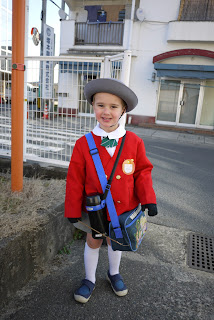

Graduation garb
In January, the kindergarten held a group birthday "party" for the 20 or so children who had birthdays in that month. The birthday boys and girls got the special privilege of sitting, unmoving, in little wooden chairs on a stage, with all of the other kindergarten children watching while their parents one by one passed a microphone around and spoke a birthday message to them.  This took at least 30 minutes and by ten minutes in, Theo was slouching, adjusting his clothing, fiddling with his chair, mumbling to himself, and in one embarrassing and horrifying moment his shoe somehow came flying off of his foot and landed a good ten feet away amongst the children in the audience. The principal and I were doing our best to glower him into stillness, but to no avail. The funny thing was, Theo seemed to be the only child who was unable to sit still. I would chalk it up to his age and gender, but there were other little boys who turned four that month sitting on the stage as well. Since then I have been searching for the near magical parenting secret that Japanese mothers possess which allows them to raise children who can sit still, staring off into space patiently for 30 minutes straight even though they are bored out of their skulls.

Theo and his bus stop friends
I think that the past 4 1/2 months have been extremely difficult for him. It is always hard to understand what is going on in the mind of a three and four year old, but until very recently it took every ounce of pleading, wheedling, bribing, and force that I had to get him out of bed in the morning, fed, dressed, and on to that school bus. When I asked him why he didn't want to go to kindergarten his usual response was that he couldn't understand anyone and they always told him "dame!" (stop or bad). Starting halfway through the year, he was the only child who had no idea what was expected of him during each activity and lesson which, knowing my child, makes him bored and disruptive. He also could barely speak a word of Japanese when he first started, which would make anyone confused and disinterested. This was all made a shade worse by the ever returning cold/cough that he seemed to catch every two weeks. He normally has a good immune system, but I think a combination of stress and never before encountered Japanese virus strains made it impossible to go for more than one healthy week at a time.

He seems to have caught on to the peace sign thing pretty
quickly
His kindergarten teacher and principal expected a steep learning curve and were amazingly understanding and kind to him as he struggled through those first miserable months. However, I have received a few phone calls from the school though their English teacher regarding his behaviour, some of which I agree with, and some which I am surprised by and ultimately ignore.

Early on, I recieved a phone call saying that he was not allowed to personalize his school things (which are identical to everyone else's in every other way) by putting stickers on them. That evening as I peeled the stickers off of Theo's water bottle which he lovingly stuck on only a few days before I tried think of reasons to tell him why I was doing it. Conformity, homogeneity, and suppression of individualism all came to mind, what I actually told him was that the other children might feel bad when they saw how pretty his stickers were and they didn't have any. He later rationalized it in his own way by saying that his teacher hates stickers.

Photo of Theo and his class as before they harvested the
sweet potatoes they grew
Another interesting phone call was about how Theo likes to sit on a toilet when he pees and absolutely refuses to use the little urinals that are in their bathrooms. They told me he is the only boy who sits and wanted me to speak with him about it and persuade him to stand like the rest of the boys. I asked him if he wanted to pee standing up sometimes and he said that he didn't like doing it that way. Unbeknownst to the yochien, I have never brought the subject up with him again. Who cares if he sits or stands when he pees? He obviously doesn't and if he begins to care a few years from now he will change.
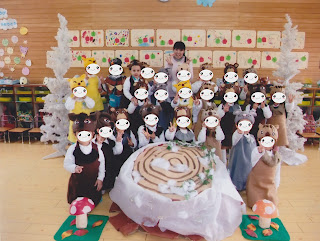
Theo and his class dressed up in their animal costumes for
the Christmas play
 Another point of contention came up about mid-January. He has an insanely vivid and active imagination and when left to his own devices he is able to entertain himself quite easily by pretending he is an astronaut, robot wizard, swordfish, or whatever catches his interest that day. Since he did not understand much of what was going on most of the time, he was left to his own devices a lot. The teachers were concerned about this pretend play and thought that he was using it as an escape mechanism to avoid the real world. Apparently, his classmates were even getting confused because when they addressed him as "Shio-kun" he would say, "No, I'm not Shio, I'm a caterpillar", or whatever he was that day. The phone call finally came after an explosive situation where the teacher told him that he was Shio-kun and nothing else. He yelled at her and ran out of the class crying saying that he hated kindergarten and wanted to go home. He demanded to talk to the principal about his feelings. Thankfully, she speaks a bit of English and was able to calm him down and let him know that what he did was not ok. I had a long and uncomfortable phone call with the English teacher that evening trying to explain that I would speak with Theo about how he reacted to his teacher and let him know that his behaviour was wrong, but that I didn't actually see anything abnormal with his imaginary play.

Theo and friends taking a breather
I actually encourage that kind of creative play at home and don't think it is wrong for a four year old to not be grounded utterly and completely in the real world. Don't get me wrong, I also find it annoying when he gets so caught up in pretending to dig up a pirate treasure that he gets distracted from dressing or feeding himself, but I also think it is good for his brain development and that he will ultimately grow out of it. Unfortunately, I don't really know enough Japanese children to determine whether Theo's hyper-imaginative behaviour is uncommon here. Even by western standards he is, as my brother-in-law put it nicely,  "out to lunch most of the time", but I see it as part of his personality and a trait that should be fostered and encouraged, not repressed.

Theo and his wolf pack
Since this frustrating call from the school, I have been working on channeling some of his imagination away from pretending and acting into drawing and painting. Whenever he gets particularly involved in pretend play of some sort, I whip out the sketch pads, markers, and paint and get him to draw me all of the things he is imagining in his head. It has been really effective in quieting the noise and seems to help him distinguish between himself and what he is pretending. I am not sure how it is going for him at school but I haven't gotten any more phone calls so I will assume it is improving.

Ready to hop on the bus
Now as the final semester of the school year is drawing to a close, I realize that Theo finally made the adjustment that we knew would be so difficult. After 4 1/2 months I have gotten the report from his principal that he understands just about everything that is said to him in Japanese and can speak in simple sentences. In the past month everything has clicked for him and he his happily climbing aboard the bus every day without a fight. He has finally topped that steep learning curve and comes home with more Japanese and reports of all the fun things he did with his friends that day. It is hard to watch your child go though something really stressful, scary, and exhausting, so I am very happy to say that the end of this school year brings a really hopeful and positive feel for the next year.


P.S. Sorry if these photos are super creepy! I don't know many of his classmates parents and couldn't ask permission to use their children's images so they became googly-eyed, kawaii head kids!

12.27.2011

We Wish You a Merry Christmas

We had an absolutely fantastic Christmas here in Fukuyama. I will be putting up pictures of our revelry as soon as I figure out how to get them off of my phone. Unfortunately, our camera, which has been taking terrible pictures from day one, is slowly becoming only able to take pictures that are not much better than a daguerrotype. A recent addition to its ineptitude is the inability to flash or focus on anything even remotely resembling a subject. The photos are usually blurry and hazy unless the subject is completely still, which I am pretty sure my children are incapable of. I have a deep and complex relationship of dislike and betrayal with this camera, which, as you can see, is turning into semi-psycotic anthropomorphising on my part. We finally gave up on the camera on Christmas Eve and opted for taking photos with the only slightly better cell phone camera. In case you are wondering why we bought such a terrible camera in the first place, we didn't. It was given to us as a replacement when our previous camera (which took decent photos) had electrical problems. Sigh.

Parliament of owls with Theo in background
Last week, Theo's kindergarten had a Christmas presentation. It was held at the Reed and Rose Arena, our city's concert hall, and included two plays and multiple songs played on the melodica. Theo and the rest of the children in the youngest kindergarten class performed a really cute but random play. The premise was as follows: All of the animals of the forest are gathered together because they have found a secret cave. A few animals enter it to explore and come out claiming to have seen great sights. They tell all of the animals to go in and see for themselves, but the foxes are too afraid to enter. It takes the rhetoric of the wise owls to persuade the foxes. After all of the animals enter the cave, they discover that it is a magical portal to the North Pole where they meet Santa, his reindeer, and elves. Santa then proceeds to take them for a ride in his sleigh and give them each a present.

Sucking on his paws
The amazing part about this play was that there was about 80 children on stage at one point. Nobody burst out crying, ran off the stage, or hurt themselves. I didn't think that it was possible to avoid at least a couple of incidents over the course of 15 minutes with that many 3-4 year olds, but somehow they pulled it off. Theo played the part of a wolf and looked incredibly bored the whole time. He spent the better part of the play looking everywhere but forward, pulling at his sleeves, and yawning. If you are wondering which one is Theo in these pictures, just look for the most distracted, glazed expression and it is bound to be him.


Studying the floor

Here is a video of the kids with Theo in front and center singing "We Wish You a Merry Christmas". The video was cut short by William who decided to burst into tears halfway through the song. 


Any advice on what we should get to replace our excuse of a camera?

12.15.2011

Fahrenheit 119... or a note on fire drills

A couple of weeks ago my school held a fire drill, that is too say that a few days before hand we had a fire drill rehearsal where we practiced having a fire drill... which is in itself a practice for a real fire so we practiced having a practice of a real event... this might sound redundant but I suppose there is no harm in being redundant when it comes to saving your life. During the rehearsal I was lucky enough to be the first person down the emergency chute from the fourth floor, which was actually a lot of fun. On actual fire drill day the buzzer sounded and all the students and teachers filed out in full Japanese efficiency to the outer field, all while still wearing their inside shoes so as to simulate what we would do if this was an actual fire. Other then the rehearsal this was very much the same as fire drills I remember from back home, however after a customary count off and reporting on how long we took to evacuate the building the similarities ended.

We were then treated to several speeches in Japanese from both the headmaster and the fire chief after which all the students were divided into three groups. Group 1 went to go watch student volunteers being rescued from the third floor by the ladder truck, a demonstration that ended with the finale of the last student getting to ride to the ladders full 45 meters. Group 2 went to go and participate in the emergency chute demonstration that I participated in during rehearsal. And I went with Group 3, where we practiced yelling "FIRE!!" and putting out a real fire with fire extinguishers.
火!
So as you can see fire drills in Japan are quite involved, in total we had a least a dozen fire fighters, a ladder truck, a tanker truck, the fire chief and an ambulance on site. All I can say is that if the school would actually catch fire, a dubious prospect given the fact that the entire building is made of concrete, that some this "training" kicks in and everyone gets out safe and sound.


p.s. as for the post title, 119 is what you dial here in an emergency... as opposed to 911.

11.26.2011

Onigiri Day

Delicious onigiri
This past Friday was onigiri day at Theo's kindergarten. Onigiri is rice that is formed into a shape, usually a triangle or ball, and usually wrapped in a sheet of seaweed. The rice can be left plain, slightly salted, mixed with toasted sesame seeds, shirasu, or other types of furikake. They are also sometimes filled with little bits of goodness, like pieces of vegetables, meat, or pickled things. Every other Friday, Theo is required to bring only onigiri as his lunch to school. He can have as many as he likes, but nothing else. I really love onigiri, and I know the Japanese do too for the most part, but it seemed a little excessive that they would enforce a special day in honour of onigiri.

What Theo thinks he is doing
at kindergarten each day

After enquiring a bit more, I was told that this is done every two weeks to make the children aware of world hunger and others in the world who do not have nice bento to eat every day. I think it is a fantastic idea, but I am really not sure if many of the children Theo's age are getting the message. After his first onigiri day, I asked him a few questions about his lunch. He told me it was a really great lunch and that there was nothing out of the ordinary with it. His words were exactly: "it was super oishii (delicious)!!". Yeah, I don't think he was given a taste of what starving children feel like. I certainly don't think most 3 year olds have a definite grasp on the real world. Just to prove a point to myself, I asked him if he had fun riding orcas and hunting dinosaurs in kindergarten that morning. The answer was, of course, an enthusiastic yes.


So, every other Friday I continue to place a few little onigiri in Theo's bento, knowing that he will be just as excited about eating it as he is with all of his lunches. Maybe by the time he is ready to leave yochien he will be old enough to understand a little bit of the reasoning behind it, but until then he will get to exclaim how oishii his onigiri is.

11.06.2011

Theo's First Week

I am not sure how it happened, but somehow in one week every bag was sewed, every last pencil and clothing article was labeled, and Theo was seen happily off to his first day in yōchien. His first day was on November 1st and the 3rd was a holiday, so he was only at kindergarten for 3 days last week. I think that the short week kept him from being too terribly overwhelmed by all of the changes.

A typical lunch that I send with Theo
It also happened that the 4th was a parent observation day which I was forced strongly encouraged to attend. It was mostly the mothers who came, but I was happy to see that there were a few dads there as well. There were about 60 parents total and we stood around the courtyard watching the daily exercise and gymnastics routine that our kids do in the morning. It was kind of sad to observe Theo's confusion first hand as he had only been there for two days. He is far too independent to just follow the other children around placidly or stand there staring into space. He was constantly darting off at top speed making for the play structures, slides, and sandbox and having to be led back by a teacher. I could tell that he was extremely bored since he didn't know what the teachers were saying, the little rhymes the kids were chanting, or the steps to the exercise routines. They were also made to stand in lines waiting for their turn to do a somersault or walk a balance beam, and his attention span just is not long enough to patiently wait for 15 kids to do a roll or flip before him. Needless to say, there were many attempted escapes to the slides and swings. At one point during the exercise routine, Theo spotted me in the crowd of parents and ran over as fast as he could, burst into tears, and said "please, I don't want to exercise anymore! They keep making me and I'm soooooo tired!". At this point he crumpled into a heap in the dirt at my feet. It was really sad, and pretty embarrassing, but for his benefit this was after at least an hour and a half of really hectic high energy music, dancing, and stretching. I am sure that after a week or two of this he will develop a bit more stamina.

kanpu masatsu
Next, the kids were allowed to go to their individual classrooms and change out of their exercise clothes, have a rigorous session of kanpu masatsu (乾布摩擦) and then dress in clean uniforms. Every student has a long, narrow towel that they bring to school each day (yes, this is one more thing that I had to sew and label). They use this towel to do kanpu masatsu, which involves rubbing the towel vigorously over their bare skin to improve circulation. I am sure it is healthy for him, but he hadn't really figured out the drill on Friday and was mostly just waving his towel around and singing. Once everyone was dressed, the teacher proceeded to take attendance. Theo thought he had this one all figured out, since every time a name was called from the attendance list, he raised his hand high and shouted "hai!". Then the giant abacus and flashcards emerged and the kids wowed me with their math and reading skills. I was impressed by their ability to count to thirty in multiples of two and count backwards from sixty. They also knew way more kanji than me and could read a simple poem in hiragana and katakana. I really had no idea that 3 year olds could do all of this!

Poor Theo seemed very confused and bored at times, but I was surprised by how much he had actually picked up after 2 days. He was able to count with the others and knew a couple of the dance routines. He actually sat at his little table with the rest of the kids and seemed mildly attentive. The teachers are great with him and seem to be giving him lots of firm but kind guidance when he gets out of line. He has made a few little friends and even got a super cute, scrawling note from a little girl in the class. At the end of each day I have asked him if he wanted to go back in the morning and each time he enthusiastically answered yes, so he can't be minding all of the changes and stress too much. I am curious to see how much he will pick up in the next few months!

A note on his name: since "th" does not really exist in Japanese, his name translates into Shiodoru. Since we call him Theo at home, the teachers decided to call him Shio. I find this kind of funny because shio is the Japanese word for salt. He absolutely loves his new nickname, and now introduces himself as Shio-chan ("chan" is a diminutive, like saying "salt child") to almost everyone he meets!

And here is a gallery of the uniforms he wears to school:

This ambiguously gendered outfit is what he wears to school each morning. It is the exercise outfit.


Here is his exercise uniform with the sunhat. Each class has an appropriately colored hat to match their class name. Since Shio is in yuri, or lily, class he gets to wear an orange hat. 


This is his normal uniform for the later part of the day and for special events. I am not really sure if both boys and girls wear the suspenders, but I am beginning to have a sneaking suspicion that it is only the girls who do...


Here is the full uniform with the jacket. Children are required to wear the little shorts even in the middle of winter. Thank goodness we no longer live in the land of skin exposure warnings and 10 minutes to frostbite or there would be a lot less Japanese children with legs!

10.30.2011

Yōchien II

Only a few days after I had decided to quit inquiring about preschools for Theo and wait for April, we met a woman who lives in Fukuyama and speaks fluent English. She asked us if we were planning on sending Theo to yōchien and I told her about all of the problems I ran into just trying to find out any information. She informed me that her 2 nephews and niece attend a great private yōchien that is in our neighbourhood, and they happened to be having their open house that coming Saturday. She also let me know that almost all yōchien have some kind of information day mid-October where you can pick up applications and all applications for the following April are due November 1st. She volunteered to go with me and translate.

At the open house, the principal covered the school's teaching philosophy and curriculum. The day runs from 9:30 am to 2: 30 pm, with exercising and sports for the first half of the day, and teaching for the last half of the day. She spoke for a while about how their goal is to help the children develop the right hemisphere of the brain and the importance of right brained activities. They teach them kanji, calligraphy, music, and dance. After listening to the principal's speech, we did a tour of all the little classrooms and the outdoor areas. There was a big open area for organized sports, a few play structures and play houses, and a garden where the children were growing vegetables. The classrooms where all friendly, bright and clean. 

My friend introduced me to the principal, who speaks a bit of English and she told me that if Theo were to attend there, they had space for him to start as early as November 1st. My friend offered to take me to other schools to check them out, but I just got the feeling that Theo would fit in well at this school. It is also very close to our apartment and my friend and her sister (who's children attend there) are, and will be invaluable resources for sorting out the language barrier. I was also able to speak with the principal about Theo's medical conditions and she seemed more than willing to work with us to keep him safe while not making him stand out too much. Well, not any more than being the only foreigner in the kindergarten makes him already stand out. We set up an appointment with the principal for an interview, uniform fitting, and filling out paperwork.

At this appointment I was given the run down of required classroom materials. Every student must have the exact same school and art supplies, and seemingly a million bags to bring all of their school things in. Each bag must have exact dimensions, and every last eraser, marker cap and pouch must be labeled with their name. Needless to say, after writing Theo's name in katakana about 300 times, I have gotten really good at it. It would have been nearly impossible to find all of the required bags in the exact dimensions specified, so I went to the fabric store and picked up a bit of really cute cloth and got busy sewing.   


His necessary bags are (top to bottom, left to right) Bento lunch box bag, water bottle bag, cup and toothbrush bag, extra pair of undies bag, folder and artwork carrier bag, shoes bag, and towel and extra change of clothes bag. 


Here is a glimpse at all of the crazy art supplies that we needed to purchase from the school. Because every child has the exact same set (can't let anyone be an individual, can we?) every last lid, cover, pastel, and cap had to be labeled to prevent it from getting lost. I don't think I have ever owned such expensive art supplies, especially not when I was 3!


We also had to purchase this awesome and slightly ridiculous instrument for Theo. It is apparently called a melodica. It is played by connecting the white tube to the end of the keyboard and blowing into the mouth piece while playing the keys. Considering it cost us about $85 Canadian, I really hope that he enjoys it.   


There are also really cute uniforms that Theo must wear, but I will be putting up photos of him in them later. 

It would have been nearly impossible for me to find my way through the application process, to understand what Theo is required to bring on a daily basis, and how the schedule and system works without the help of an interpreter who was willing to sift through a mountain of papers and answer my every last question. I wish that I had some advice to give for someone looking for a yōchien for their child, but it seems like we just had a stroke of good fortune and circumstance in finding connections.
  

10.20.2011

Yōchien

Before we came, Dustin and I had discussed the option of placing Theo into Japanese preschool, or yōchien, so that he could learn the language faster. At the time, we thought it best to wait at least 6 months to let him adjust to the stress of moving before throwing him into a completely foreign Japanese speaking environment on a daily basis.

I have heard numerous times that children adjust to a major change in their lives extremely quickly. I was sure that Theo would adapt to our move rather fast, but I was surprised to find that he has had no adjustment period as far as I can tell. Sure, it took a few days to smooth out his sleeping schedule when we first arrived, but from day one he has been happy with the food, likes our apartment, loves to sleep on futons, and does not seem bothered in the slightest that he can only communicate with very few people. He hasn't seemed withdrawn, irritable, or in any way not his usual energetic self. Actually, in many ways he seems to be doing better here. You might think that he just isn't old enough to fully understand his situation, but I believe he does. He is aware that we are in Japan and that Canada is on the other side of the world, therefore we cannot visit family except on Skype. He knows we aren't going back anytime soon and seems perfectly content with that. It is almost eerie how well he has transitioned to life here, since I was fully expecting at least a month or two of abnormal behaviour.

In light of this, I began to inquire about preschools about a month ago. I discovered that in Japan all schooling under the age of 6 is completely voluntary. If you do choose some form of preschool or child care, you have two options:  hoikuen (or hoikusho) and yōchien. Hoikuen is more or less equivalent to our daycares back home and take children ranging in age from very young infants to 6 years old. They provide full day care and do not usually have any sort of teaching curriculum, just free play. Unlike Canada, you are only allowed to enroll your child in a hoikuen if you can prove you are unable to look after them at home, i.e., if you are working full time, have a newborn baby, or are caring for a sick elderly parent. Yōchien is very similar to kindergarten or preschool in Canada. They are usually run privately, have shorter days, and some sort of curriculum that they use to teach the kids. Only children aged 3 - 6 are allowed to go to yōchien. Because they are private, they are usually more costly, have uniforms, and require that the parents are fairly involved with volunteering, activity days, etc.

Because I am not able to prove that I cannot care for him at home, yōchien was our only real option. I had no idea how to find them in our area or how even apply once I did find one. Everything seems to be completely word of mouth and I realized that I would never be able to find out which ones were better or had a curriculum that I agreed with. Finally I decided to enquire at the foreign resident help desk at our city hall.  They basically located the closest one on the map, gave me the phone number and address, and told me that he could not be put in half way through the year, but had to wait until April (the beginning of the school year).

At this point I mostly gave up, hoping that by April my command of Japanese would be a bit better so that I could look around a bit more before commiting to a school.

To be continued...